Tuesday, 27 October 2015

Who pays for energy efficiency?

It's an easy question for owner-occupiers to answer - they do - unless they can get a grant which is becoming more difficult.
For private tenants it's a question of negotiating with the landlord - some will agree to pay for a depreciated amount when the tenant laves.
For social housing tenants, there will be a clear policy in each case.
There are some things where it is almost always worthwhile for the tenant to pay - for example low energy light bulbs, when an old filament bulb needs replacing. The question then is what to replace it with? A relatively cheap compact fluorescent, or a more expensive but more efficient LED? This will depend on the relative costs. it is usually well worthwhile for the tenant to do basic draughproofing of doors and windows, 
To find out what grants are available, a good place to start is the Governments own webpage on the subject,

https://www.gov.uk/energy-grants-calculator 


Monday, 14 September 2015

Draughproofing

It's cheap, it's easy, and it saves a lot of money if you have an old or draughty house.
One wag told me that draughtproofing my letterbox would cut my bills because they wouldn't be able to be delivered through the smaller opening!

A draughty letterbox sealed with six inches of foam-backed tape.

A DIY job on a door was not very pretty, but is invisible when the door is shut-

A  little used door is now much less draughty... 


My front door is beginning to warp and let in air; quite common in damp Devon, but instead of getting an expensive job on the door, I put a wooden batten on the frame-

DIY perfectionists might not like it , but it works!

To see the Energy Saving Trust experts' view go to https://www.youtube.com/watch?t=110&v=XOuCzuL2qeU

Thursday, 3 September 2015

How much do different electrical appliances consume?


There are two very useful devices that I use to measure how much electricity I am using. The one pictured above is an Owl monitor. It measures the total amount of electricity used in a house. You clamp a sensor on to the main cable going into your meter, which sends a wireless signal to the Owl monitor.
It tells you the instantaneous power consumption in kilowatts, and will also tell you how many units you have used over time. You can even plug it into your computer and look at graphs of consumption by the day, hour or even minute over the previous month.

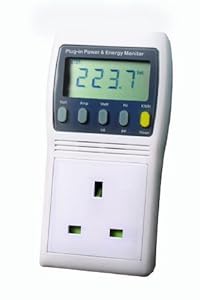
This one is a plug in device that tells you how much electricity a particular appliance is using, also instantaneous and over time.
I was surprised to learn that there was a big difference between a new and an old freezer I had. The old one used about 50 watts on average, the new one only 14!
I lent mine to a neighbour who is busily looking at how much his appliances use.

Both of these are readily available online, just search "Owl monitor" or "plug in electricity monitor". 

Friday, 28 August 2015

Welcome to Cosy Newton St Cyres!


Newton St Cyres is a village outside Exeter. We have several hundred houses in the village, of all shapes, sizes, ages, tenures and energy ratings.
There are more than a few listed houses, often with very old cob walls (adobe or mud, several feet thick).
I had a get together on the 22nd August with a few other owners to discuss how we could collect and disseminate knowledge about practical steps to make our homes more energy efficient.

There were some surprising outcomes, as well as some predictable ones.


Spot the secondary glazing!

Listed homes are restricted in what they can do to save energy, for example double glazing is frequently prohibited. But secondary glazing, if it can be removed, is not.
I looked into secondary glazing for Bailey Farm, which has about 20 windows in all.
To get professionally installed secondary glazing would cost aboput £400 per window, and that's with no remedial work on the existing windows, i.e. about £8000.
I looked into doing it myself, and discovered a system called Magnetglaze Pro, which for a material cost of about £1000 and about a week's work I used to do the whole house. 
That was last autumn, and the house was very noticeably warmer and easier to heat over last winter.
Is it as good as the expensive professional system? Probably not quite, but it certainly works, and is probably better value for money. It is also virtually invisible unless you are looking for it, and easy to take out and refit to clean the original windows.
All the windows still open without removing it (except the one in the picture, which was the first one I did!) so we are very pleased.